


Waking up with a stiff, sore neck can ruin an otherwise good night’s sleep. For side sleepers, the problem may sometimes be surprisingly simple: your pillow is not giving your head and neck the support they need.
Sleeping on your side creates a space between your head and the mattress.
Your pillow has to fill that space without pushing your head too far upward or allowing it to sink too far downward. When the height and support are wrong, your neck can remain in an awkward position for hours.
That is why finding the best pillow for side sleepers with neck pain is not simply a matter of choosing the softest, thickest, or most expensive pillow available. The right choice depends on pillow height, firmness, material, shoulder width, mattress firmness, and even how much you move during the night.
A good pillow cannot diagnose or treat the underlying cause of chronic neck pain. However, the right support may make your sleeping position more comfortable and help reduce unnecessary strain on your neck.
Here is what side sleepers should know before buying their next pillow.
Why Side Sleepers Need More Pillow Support
Imagine standing upright with your head tilted toward one shoulder for several hours. It probably would not feel very comfortable.
Something similar can happen while you sleep if your pillow does not adequately fill the distance between your shoulder and head.
Side sleepers generally need more pillow height, often called loft, than back sleepers because the shoulder prevents the head from resting close to the mattress.
A pillow that is too thin can allow your head to tilt downward toward the mattress.
A pillow that is too thick can push your head upward in the opposite direction.
Ideally, your pillow should support a comfortable, relatively neutral position rather than forcing your neck sharply in either direction.
Research suggests that pillow characteristics can matter. A systematic review and meta-analysis published in Clinical Biomechanics examined studies involving different pillow designs and found that pillow height and shape may influence cervical alignment. The researchers also found evidence of improvements in some neck pain and waking symptoms with certain pillow types, although the research does not establish a single perfect pillow for everyone.
The systematic review on pillow design and neck pain is a useful reminder that choosing a pillow should involve more than marketing claims.
More recent research also urges caution. A 2025 systematic review found limited evidence supporting specific pillows as an additional strategy for chronic neck pain, but no particular material, including latex or foam, clearly emerged as universally superior.
In other words, fit matters.
What Makes a Good Pillow for a Side Sleeper With Neck Pain?
Rather than searching for one magical pillow, look for characteristics that match your body and sleeping environment.
1. Enough Loft to Fill the Shoulder-to-Head Gap
Loft describes the height or thickness of a pillow.
Side sleepers commonly benefit from medium to higher loft because the pillow needs to occupy the space created by the shoulder. However, taller is not automatically better.
Your ideal height depends partly on:
- Shoulder width
- Head size
- Mattress firmness
- Pillow compression
- Sleeping position
- Body size
People with broader shoulders may need a higher pillow than people with narrower shoulders.
Your mattress matters too. On a soft mattress, your shoulder may sink farther into the bed, reducing the amount of pillow height you need. On a very firm mattress, your shoulder stays higher, potentially creating a larger gap between your head and mattress.
This is one reason universal recommendations such as “side sleepers need a 5-inch pillow” can be misleading.
2. Support Without Excessive Hardness
A supportive pillow does not have to feel like a brick.
You want enough resistance to keep your head from collapsing deeply into the pillow during the night, while still having enough cushioning to remain comfortable.
A very soft pillow may initially feel luxurious but compress excessively after you lie on it.
An extremely firm pillow can create uncomfortable pressure around the ear, jaw, and side of the face.
For many side sleepers, a medium-firm pillow provides a practical balance between cushioning and support. Individual comfort still matters, so treat firmness labels as a starting point rather than a medical prescription.
3. A Material That Maintains Its Shape
Pillow materials behave differently under the weight of your head.
Memory foam tends to contour around the head and neck. Solid foam generally maintains its shape more consistently, while shredded foam allows greater adjustability.
Latex tends to feel more responsive and springy than traditional memory foam and may resist flattening.
Fiber-filled pillows often feel softer and more traditional, but some can compress significantly during the night.
Research comparing pillow materials has produced mixed findings. Some earlier studies favored rubber or latex-style pillows for certain waking neck symptoms, while newer reviews have concluded that the available evidence is not strong enough to declare one pillow material the best choice for everyone.
The practical lesson is to focus on whether a pillow maintains an appropriate height for your body throughout the night.
The Best Types of Pillows for Side Sleepers With Neck Pain
There are several pillow designs worth considering when shopping for better neck support.
Adjustable Loft Pillows
An adjustable pillow is one of the most practical options for side sleepers because you can add or remove filling until the pillow reaches a comfortable height.
This solves one of the biggest problems with buying pillows online: you do not know exactly how a fixed-height pillow will interact with your shoulder width and mattress.
Many adjustable pillows use shredded memory foam, latex pieces, microfiber, or a combination of materials.
They can be especially useful for people who switch between side and back sleeping because the amount of filling can be customized.
When comparing adjustable pillows, look for a design that makes removing and replacing filling easy.
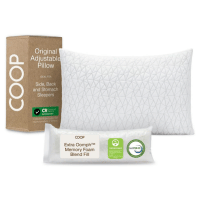
Coop Home Goods Original Adjustable Pillow
A practical option for side sleepers who want more control over pillow height and firmness. The removable fill lets you adjust the loft instead of relying on a fixed-height pillow.
- Add or remove fill to adjust loft and firmness
- Cross-cut memory foam and microfiber fill
- Extra fill included for additional customization
- Breathable Lulltra fabric cover
- CertiPUR-US and GREENGUARD Gold certified
As an Amazon Associate, we earn from qualifying purchases.
Contoured Cervical Pillows
Cervical pillows usually have curved or raised sections intended to support the neck.
They are often marketed specifically to people with neck discomfort.
The design can work well for some sleepers, but the word “cervical” on the package does not guarantee that the pillow will fit your anatomy.
In fact, research has not consistently demonstrated that a contoured foam pillow is automatically better than a regular-shaped pillow.
The important question is whether the contour actually fits your neck and sleeping position.
Side sleepers should also check whether the side portions of a cervical pillow are high enough to accommodate their shoulders.
Latex Pillows
Latex pillows are worth considering for sleepers who want a responsive pillow that does not collapse easily.
Instead of the slow sinking sensation associated with some memory foams, latex usually pushes back more quickly and maintains its shape.
This can be helpful for side sleepers who need consistent loft.
Some studies have reported favorable results with rubber or latex pillows, but this should not be interpreted as proof that latex will eliminate neck pain.
Latex pillows can also feel too springy or firm for people who prefer deep cushioning.
Memory Foam Pillows
Memory foam remains one of the most popular materials in pillows designed for neck support.
Solid memory foam provides a stable shape and gradually conforms around your head. Shredded memory foam is generally more adjustable and breathable.
For side sleepers, the biggest advantage is the material’s ability to provide cushioning while resisting the immediate flattening common with some traditional fiber pillows.
However, memory foam can retain heat, and some people dislike the sinking sensation.
If you sleep hot, consider ventilated foam, shredded foam, cooling covers, or other breathable designs.
Hybrid Pillows
Hybrid pillows combine materials to balance support, softness, and temperature regulation.
For example, a pillow might use a supportive foam core surrounded by softer fiber. Another might combine shredded foam with microfiber.
Hybrid construction can be useful for side sleepers who want strong support without the dense feel of a solid block of foam.
The tradeoff is that hybrid pillows can be more expensive and sometimes more difficult to adjust.
How to Tell If Your Pillow Is Too High or Too Low
You do not need sophisticated equipment to notice an obviously poor pillow fit.
Lie in your normal side-sleeping position and have someone look at your head and neck from behind.
If your head appears to tilt noticeably toward the mattress, the pillow may be too low or too compressible.
If your head is pushed upward toward the opposite shoulder, the pillow may be too high.
Your neck should look reasonably aligned with the rest of your spine rather than sharply bent to one side.
Pay attention to what happens in the morning as well.
A pillow deserves reconsideration if you consistently wake with more neck stiffness or discomfort after sleeping on it, particularly if the symptoms improve after you get out of bed and begin moving.
Your Mattress Changes Which Pillow You Need
Pillow recommendations often ignore the mattress, but the two work together.
Suppose two people have identical shoulder widths and use identical pillows.
One sleeps on a soft mattress that allows the shoulder to sink several inches.
The other sleeps on an extra-firm mattress with very little shoulder compression.
Their heads will end up at different heights relative to the mattress surface.
This means a pillow that works perfectly on your current mattress may feel completely different after you replace your bed.
When shopping for a pillow, think about your entire sleeping position rather than evaluating the pillow in isolation.
What About Shoulder Pain?
Side sleepers with both neck and shoulder discomfort have an additional challenge.
Sleeping directly on one shoulder places pressure on that side of the body. A pillow can help position your head, but it cannot completely eliminate pressure created by the mattress.
Your mattress should provide enough cushioning around the shoulder while still supporting your body.
Some side sleepers also find it comfortable to hug a second pillow. This can support the upper arm and may prevent the top shoulder from rolling excessively forward.
A pillow between the knees can also make side sleeping feel more balanced by supporting the lower body.
Don’t Ignore the Rest of Your Sleep Routine
Finding the right pillow is only one part of sleeping comfortably.
Your bedroom environment, sleep schedule, evening habits, stress levels, caffeine consumption, and exposure to bright screens can all influence how easily you fall asleep and how rested you feel the next morning.
If falling asleep is part of the problem, simple science-backed methods for falling asleep naturally can complement improvements to your physical sleep environment.
Nutrition and lifestyle may also influence sleep. Magnesium, for example, is frequently promoted for relaxation and sleep, although its effects and the quality of evidence vary depending on the population and circumstances. Understanding the relationship between magnesium, sleep, and relaxation can help separate reasonable expectations from exaggerated supplement claims.
What to Look for Before Buying a Pillow
If you are comparing pillows online, do not focus only on star ratings.
Check the specifications carefully.
For side sleepers with neck discomfort, consider:
- Loft or pillow height
- Adjustable versus fixed filling
- Firmness
- Material
- Amount of compression
- Neck support
- Cooling and breathability
- Pillow dimensions
- Washable or removable cover
- Allergen considerations
- Trial period
- Return policy
- Manufacturer warranty
The return or trial policy is particularly valuable.
Pillow comfort is highly individual, and a product with thousands of positive reviews can still be wrong for your shoulder width, mattress, and preferred sleeping position.
Whenever possible, choose a pillow that gives you enough time to evaluate it over multiple nights.
Expensive Does Not Automatically Mean Better
A $150 pillow is not necessarily three times better for your neck than a $50 pillow.
Premium materials, certifications, cooling fabrics, adjustable construction, and longer warranties can justify higher prices. But price itself does not determine whether your neck will be properly supported.
A relatively inexpensive pillow with the correct height and firmness may suit you better than a luxury pillow with the wrong dimensions.
This is why pillow shopping should begin with fit and support rather than brand prestige.
Should You Stack Two Pillows?
Stacking two standard pillows is an easy way to create more height, but it is not always the best solution.
Two pillows can shift independently during sleep and may create an unstable or excessively elevated surface.
If a single pillow is consistently too low, a higher-loft or adjustable pillow is usually easier to control than stacking several soft pillows.
However, there is no rule saying everyone must sleep with exactly one pillow. What matters is the resulting position and comfort of your head and neck.
Give a New Pillow Some Time, but Pay Attention to Pain
A different pillow may feel unusual during the first few nights simply because your body is accustomed to your old one.
That does not mean you should force yourself to tolerate worsening pain.
If a new pillow repeatedly causes increased neck pain, headaches, numbness, tingling, shoulder or arm symptoms, stop using it and consider discussing your symptoms with a healthcare professional.
Persistent neck pain may have causes that have little to do with your pillow.
When Neck Pain Needs Medical Attention
A pillow is a comfort and positioning tool, not a treatment for every type of neck pain.
Consider seeking medical evaluation if your neck pain is severe, persistent, follows an injury, or is accompanied by symptoms such as weakness, numbness, tingling, problems with coordination, fever, unexplained weight loss, or pain that radiates into your arm.
You should also talk with a healthcare professional if neck pain regularly interferes with sleep or daily activities.
A physical therapist or other qualified clinician may be able to evaluate your posture, movement, sleeping position, and other factors contributing to your symptoms.
So, What Is the Best Pillow for a Side Sleeper With Neck Pain?
There is no single pillow that can legitimately be called the best for every side sleeper with neck pain.
For many people, a strong starting point is a medium-firm pillow with enough loft to fill the space between the shoulder and head without forcing the neck upward. Adjustable-loft pillows are particularly appealing because they allow you to fine-tune that height at home.
Latex, memory foam, cervical, and hybrid pillows can all be reasonable options when their dimensions and support match the sleeper.
Rather than buying a pillow solely because it is labeled “orthopedic” or “for neck pain,” evaluate how it actually positions your head.
The best pillow is ultimately the one that provides comfortable, consistent support for your particular body, mattress, and sleeping position.
The Bottom Line
Side sleeping does not have to mean waking up with a stiff neck.
Your pillow has an important job: filling the space between your head and mattress while supporting a comfortable neck position for hours at a time.
When choosing a pillow for side sleeping, pay particular attention to loft, firmness, compression, adjustability, and how the pillow interacts with your mattress. Materials such as memory foam and latex can offer useful support, but current research does not justify declaring one material universally superior for everyone with neck pain.
An adjustable pillow with a good return policy can be a sensible place to start because it allows you to experiment with height rather than guessing.
Most importantly, do not expect a pillow to cure an underlying neck condition. Think of it as one component of a healthier sleep setup.
When the pillow fits your body instead of forcing your body to fit the pillow, you have a much better chance of waking up comfortable, rested, and ready to start the day.
